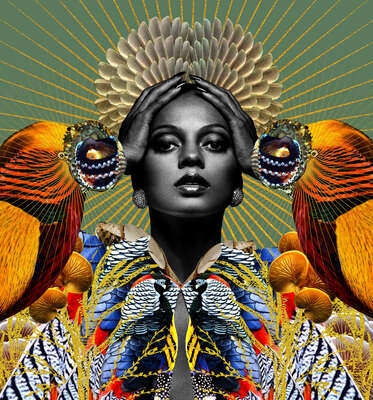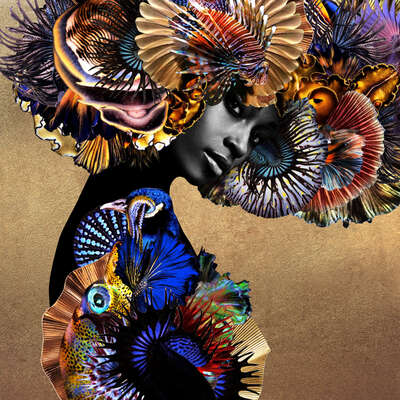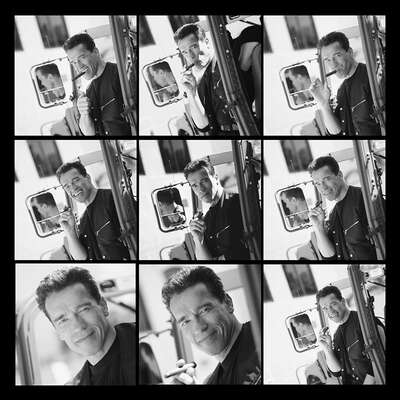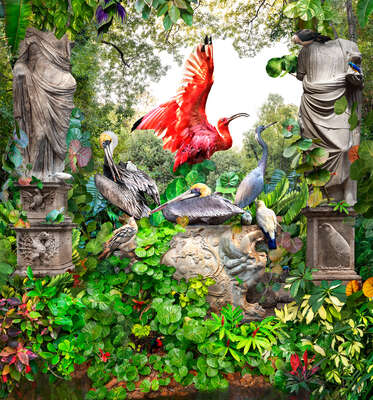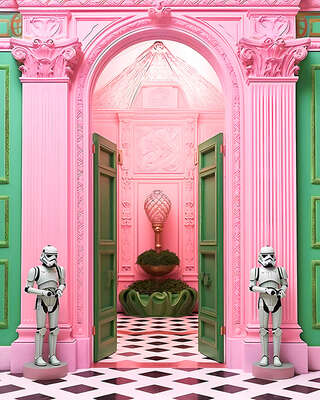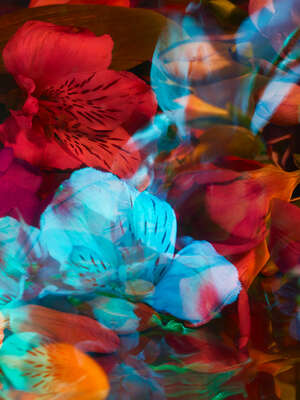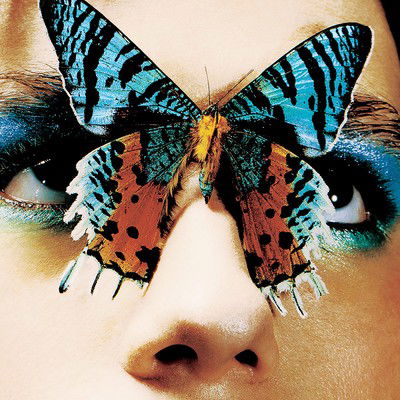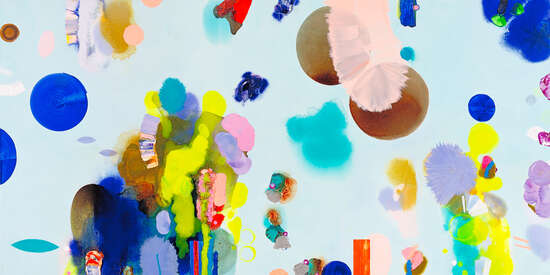













- GooGoo Muck
- Human Fly
- Lemon Twist
- Wang Dang Dula
- Introduction
- CV
- Exhibitions
- Publications
Glaring Messages out of the Darkness
In the history of the photogram, Natalie Ital connects to what her teacher Floris M. Neusüss at the Gesamthochschule in Kassel conveyed, and hence to the work of the artist who has set the authoritative accent in the field of photogram for several decades. Since completing her studies in visual communications in 1993, she has developed a markedly personal signature, which many prizes, as well as solo and group exhibitions, attest to.
The most obvious difference of her work from that of her teacher - who very insistently worked in classic black-and-white – is the evident colors she consistently uses. But she also went her own way in terms of motif design. Among the clearest signs of emancipation are her art books, in which her photographic works, since 1990, are collected in handsome sequence. She publishes these herself in small editions.
Highest Concentration when Playing with Chance
Her color works assemble the most diverse objects and also deviate from classic photograms in that negative, as well as positive images, mix over a large area. She lets musical icons of the 1950s or 1960s like Elvis Presley come back to life, orincorporates toys with familiar crustaceans, allowing Barbie & Ken or even skeletons to find a home in her pictures. This conveys clear evidence that she wants to blast away established image patterns. Finally, we again find examples connected to Floris M. Neusüss –body images of unnamed persons who come entirely from her personal circle of friends and who agreed to her creative experimentation in the dark. Working in a totally dark room inevitably involves a certain randomness in the creative realization. The point is to be able to connect the bodies with the most varying objects and elements according to pre-developed ideas. Naturally, the artist evaluates the picture produced at the end of each single, highly-concentrated work process herself. She decides what is good enough technically, aesthetically, and in terms of content to present to the public.
Emotional Contrasts
Pleasantness and convention are the least desirable for Ital; consequently, the chaotic-anarchic traits of her pictures are completely in line with what she aims for. She works just as purposefully with contrast: beautiful corresponds to ugly, the flattering with the threatening, death with life. With this creation achieved through tension, she wants to sound out conscious emotions with the viewers, who aren’t exhausted with indifferent pleasure, but react with actual feelings.
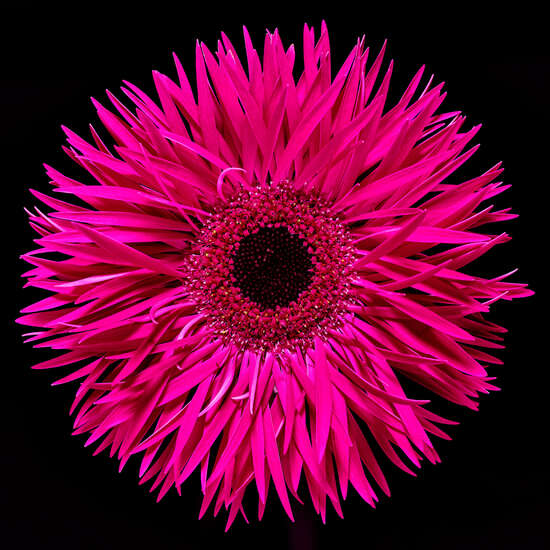
Above all, it’s colorfulness, that belongs to the permanent mix of diverse motifs, picture sources and technical precursors, that Ital fuses with such virtuosity. She applies color intensively, enhanced in part by color filters. Her pictures thus radiate expression, dynamism and at times, even garishness. A total embodiment emerges, which, for obvious reasons, associates with our everyday routines, the personally experienced, and even more, that which is conveyed to us through television. Also addressing this are picture titles such as Lemon Twist, Catfish Boogie or Googoomuck. This correspondence goes as far as the formal design of her photograms, because don’t we constantly experience the collision of the most diverse and mutually exclusive elements? Seen in this way, the photograms, intentionally glaring as well as highly condensed, deliver the emphatic, practical proof that this old art form is by no means out-dated, but on the contrary, can be applied today thanks to its potential. As products of analog technology, her photograms demonstrate in the end that despite the boundless rise of digital photo technology today, it’s still possible to be artistically hip using old photographic techniques.
Dr. Enno Kaufhold