





• Selection
  • Hudson River waterfront, New York
    Hudson River waterfront, New...
  • Lower Broadway, New York
    Lower Broadway, New York
  • Empire State Building
    Empire State Building
  • Die 9th Avenue Hochbahn im Sommer
    Die 9th Avenue Hochbahn im...
  • Introduction
  • CV
  • Exhibitions
  • Publications
  • Links

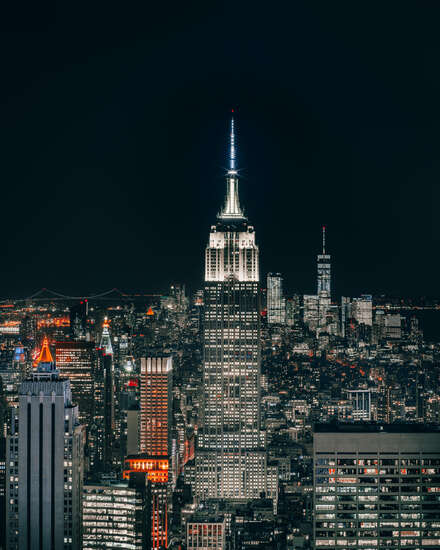
Born in Paris in 1906, raised in Berlin, and educated in Bauhaus architecture in Weimar and Dessau, Andreas Feininger, the oldest son of the famous painter Lionel Feininger, settled in New York in 1939, where he remained for the rest of his life. New York, with its skyscrapers, powerful wharfs, and enormous ocean liners, the never ending boulevards, elevated trains, and deep urban canyons, which offered the perfect backdrop for his photographic and experimental disposition. Andreas Feininger was less of a feisty photo reporter with a quick little camera than he was a highly accomplished perfectionist with a heavy view camera, five-legged tripod, and long exposures. As an ingenious tinkerer in his younger years, he not only developed a swiveling enlarger made out of wood, but also built an enormous telephoto lens out of boxes and a 28-inch lens from a flea market. The long focal length allowed him to capture even the tallest buildings in New York, such as the Empire State Building, with an undistorted perspective and a balanced size-ratio. “In order to see as the camera sees, a photographer must silence all of his senses,” he once said, emphasizing what he finds important in photography. What determines an image, more than the fleeting atmosphere present while shooting the photograph, is the emotion that comes from the image itself. This determines the degree of perfection and essence that makes a successful image immortal. Feininger looked at photography almost scientifically, yet without allowing his pictures to become boring. Quite the contrary, not only his formally perfect prints, but especially his publications and creative handbooks enjoyed great popularity. What he learned in his daily use of a camera for the legendary New York-based magazine “Life,” he excitedly and inspiringly passed on to inquisitive youth. A star portraitist such as Peter Lindbergh once said that his interest in photography began with Feininger’s book “Creative Photographer.” For Feininger, the language of photography was the only language that could be understood around the world – and his images of New York continue to win the world over until today. Although long considered classics, they still feel freshly captured from a specific time in the city’s past. Like a time machine, they catapult the viewer back to decades long gone. In view of the beauty of their perfect form, one wishes time had stood still. His images, his photographic inventions, his useful books, and his reflections on photography reveal Andreas Feininger to have been a modern genius.

Stephan Reisner

  • LUMAS Featuring

    You may also like these artists

  •   BERENICE ABBOTT 
    BERENICE ABBOTT
Recent images:0
Bookmarks:0
Cart:0
Added to cart
Removed from cart
Newsletter